Home Donate NewSearch Gallery Reviews How-To Books Links Workshops About Contact
Secrets of iTunes
A recording engineer's guide to importing CDs
© 2014 KenRockwell.com

This free website is supported when you lot employ any of these links when yous get anything, regardless of the country in which y'all alive. Thanks! Ken.
July 2014 All Reviews Sound Reviews Apple Reviews
Quick Overview
There are a zillion settings in iTunes, just most make big files that limit how many songs will fit, while others don't sound as proficient.
I'll get into details below, simply here are the best settings to use to import your CDs into iTunes (and therefore your iPods, iPads and iPhones) with perfect fidelity, as well as fitting every bit many songs as possible into these devices.
This is how to do it in iTunes 11. I've used the same settings since 2006 and will use these in the future. Different versions of iTunes will accept unlike ways to ready these, but the values to set remain the same.
Settings for Popular Music
For 99% of the music most people honey, like rock, jazz, AOR, country, hip-hop, funk, jazz, techno, popular, R&B, rap, western, reggae, Christian, punk, bayou, industrial, disco, Latin, gospel, bluegrass, folk & etc., fix:
AAC (Apple Advanced Coding).
128 kbps (kilobits per 2nd).
VBR (Variable Flake Charge per unit).
Fault Correction ON.
Settings for Classical Music
Popular music is actually recorded with multiple mono mics, which makes it easier to encode efficiently.
For acoustic classical, bizarre, medieval, renaissance, romantic, chamber music and opera that'southward actually recorded in existent stereo with spaced stereo pairs of microphones, we need to import our CDs with slightly college data rates to capture all that extra stereo information. This is because the start thing that suffers with reduced data rates is that the stereo paradigm starts to collapse at softer levels and in reverberation tails.
For classical music, I import my CDs at these settings just to be safety:
AAC.
160 kbps.
VBR.
Mistake Correction ON.
Why not other settings?
These settings are from my own research into what settings sound exactly like the original CD while listening on land of the art pro audio gear. Honestly, even at 96 kbps AAC VBR it still sounds really, really good. 128 or 160 kbps AAC VBR sounds 100% perfect, while 96 kbps VBR sounds 95% perfect even on an advanced audio organisation.
If y'all're happy with net audio, you're probably simply getting 80 kbps (lxxx kbps AAC HE (High Efficiency)) which sounds well-nigh 90% perfect. Satellite radio like Sirius XM sounds relatively atrocious because it's only about twenty kbps. 128 or 160 kbps AAC sounds perfect.
Feel costless to use higher information rates, like Apple's current default of 256 kbps AAC VBR, but the music won't sound whatever better and you'll only exist able to fit half as many songs on your device. Apple tree'south default used to be 128 kbps with no VBR.
VBR (Variable Bit Charge per unit) is a newer and smarter way of encoding music. Apply it. Information technology gives improved sound because it lets iTunes use a few more bits wherever information technology needs to to optimize the sound. The only reason not to use VBR is if y'all have an ancient iPod incompatible with VBR files.
Don't use MP3, which is a very pop but junior older format. Information technology's much less advanced than AAC, so it doesn't audio equally good at any given data rate or file size. You'll need about 320 kbps for an MP3 to sound as good as a 128 kbps VBR AAC. Simply use MP3 if y'all demand compatibility with ancient non-Apple tree players. A 128 kbps MP3 isn't going to audio very good.
Apple tree Lossless (ALC) and AIFF make huge files that don't audio any improve than 128 or 160 kbps, only consequence in huge files and much fewer songs fitting on your device. ALC and AIFF are intended for scientific, testing or product purposes, not for enjoying every bit much music as possible in a portable device.
WAV is a huge file for windows computers. Ignore WAV files for portable devices.
How to Import CDs in iTunes eleven
Under iTunes > Preferences > General, be sure to select Evidence CD for "When a CD is Inserted," and that "Automatically recall CD track names from Internet" is checked, both as shown here:
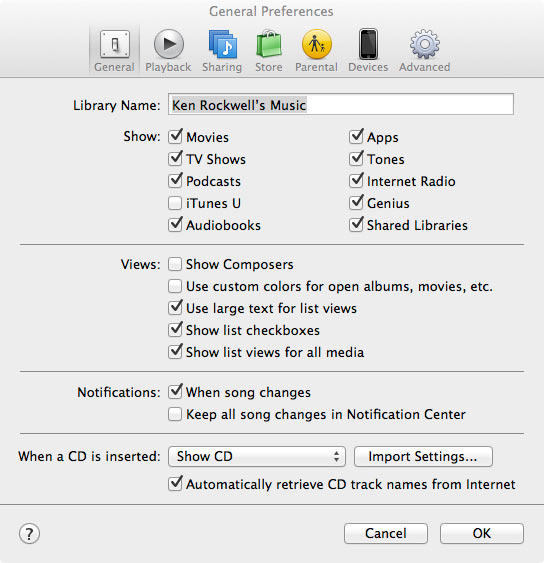
iTunes 11 > Preferences > General.
Once this is set, put your CD into your estimator. If your computer has no CD bulldoze, utilise an external bulldoze.
The CD should pop up in iTunes like this. iTunes' preferences can be set many ways and yours will probably look dissimilar; the important office is to click the CD so you accept the contents of the CD displayed and have an IMPORT CD button to click someplace. As shown here, it's on the top right:
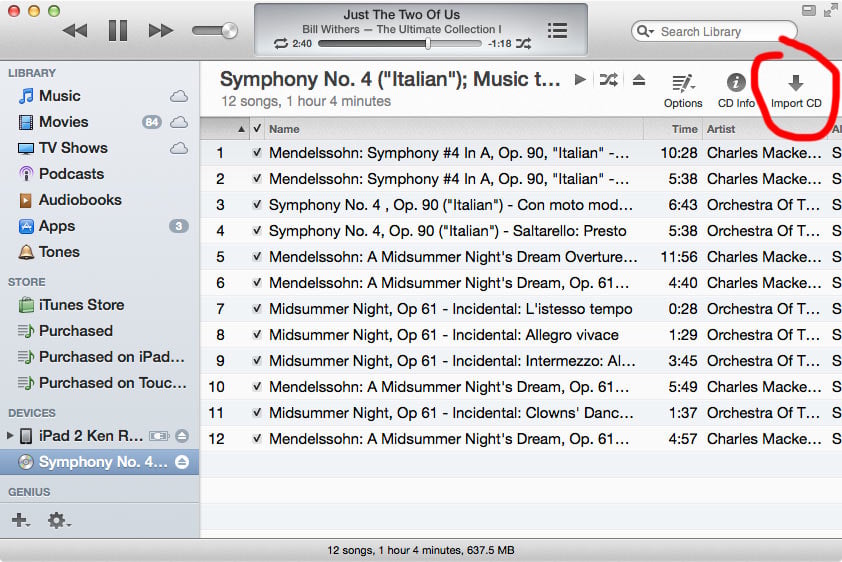
iTunes eleven about to import a CD.
Click IMPORT CD, and you'll become these options (yous also can set these back at Preferences > General > When a CD is inserted > Import Settings):
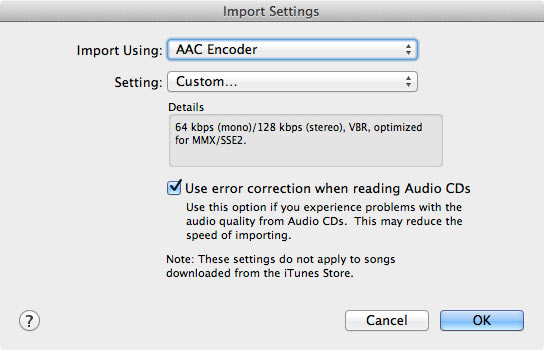
iTunes xi import CD options.
"Import Using" selects among many file formats. Select AAC (Apple tree Avant-garde Coding) equally shown hither. AAC sounds the best for whatsoever given file size.
Exist certain to bank check "Use error correction when reading Sound CDs." If you lot forget, you'll probably go clicks and pops!
Click the "Setting:" selector and select and click Custom, and you'll see this box:
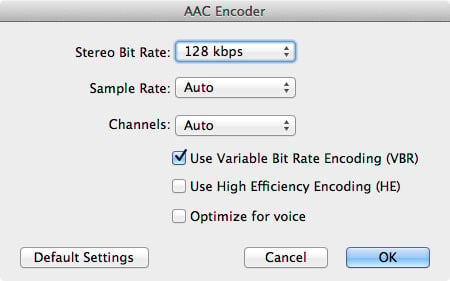
iTunes 11 import CD options for well-nigh music.
Hither's where you select the bit rate (128 kbps shown here), besides as the important "Use Variable Chip Charge per unit (VBR)" option. Be sure VBR is checked, and non the other two below it. (HE encoding only works at 80 kbps and below.)
Hit OK, and your CD will import to your computer.
With iTunes xi, you'll usually even get the artwork with it.
How to catechumen larger files to VBR AAC in iTunes 11
First, fix your import preferences as above (128 kbps VBR AAC, or 160 kbps VBR AAC for classical), then right-click a song in iTunes. Select "Create AAC Version" and you're good to go.
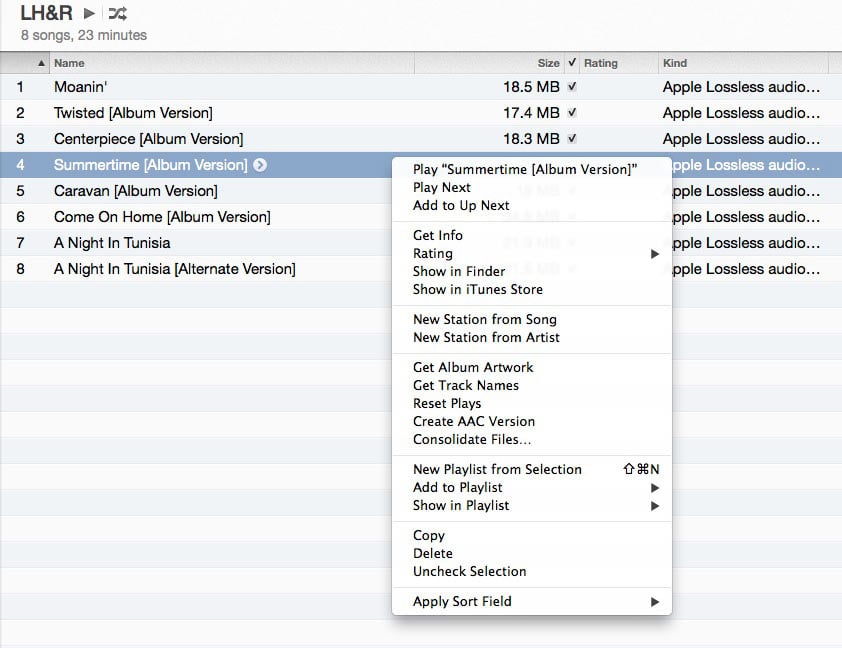
Converting files in iTunes 11.
You also can exercise this from the top carte bar every bit File > Create New Version.
Older article from 2006
My wife got herself a 4GB white Nano iPod in 2006. I was volunteered to fill it with her CDs.
I wanted to exist certain that I simply had to import our 600 CDs once. I needed to ensure I did it right the first fourth dimension then I'd never have to become back and practice it over again in the years alee. I needed to discover the optimum settings to fit equally much music every bit possible into any iPhone, iPod or iPad, and still have it sound perfect, exactly like the original CD.
CDs sound extraordinary. The but limitation is how well your CDs are recorded in the first place, which is a different story. Use iTunes properly, and y'all tin have perfect sound forever encoded efficiently on your computer and on all your portable players.
In a quondam life I worked in sound for a living, and even wrote an technology newspaper on audio data compression. Back in the 1990s, compressed data rate audio didn't sound very expert, even at 384 kbs. I wasn't expecting much from an iPod since I presumed the sound quality was atrocious. Incorrect! These fiddling things sound smashing, especially for serious music listening, if you encode your CDs properly in iTunes as I'll explain.
Audiophiles who've never really listened to an iPod volition tell y'all they audio poor, but as a musician who uses my iPod Touch to feed the tube amplifier that drives my reference Stax SR-007 Omega II headphones, mine sounds awesome! Follow these instructions and yours will, too — especially if y'all're using summit-notch professional electrostatic gear. There'due south no better way to organize and get to your music fast than with iTunes and iDevices, and so have at information technology. There'south no need for exotic music players and servers when the Apple devices already audio so great, and no other device makes information technology and then easy to find your music.
Today we take more storage space than when I first wrote this in 2006 — but I also take a bigger music collection, and today I want to carry it all with me on my iPod. My 64 GB iPods and iPads still can't hold all my music, so thoughtful consideration to the optimum fleck charge per unit is equally important as ever — unless you don't really similar music and only heed to one anthology.
Information technology's important to encode your CDs in iTunes into files as small as possible so you lot can have as much of your music as possible y'all in your portable devices, and the files have to be large enough to sound perfect.
So what's the best setting?
iTunes
iTunes is Apple'south free software used to copy all your CDs into your estimator and then yous can load them into an iPod. It also allows you to play and manage your entire CD library from your computer, and it sounds great for serious listening.
The AAC coder in iTunes sounds smashing at 128kbs AAC VBR, and that's for serious listening on high-end audiophile systems with your eyes airtight and your full attention on the music. Just plug in a set of professional headphones that cost more than the iPod, or plug the i ounce Nano, which is smaller than a business menu and ane/4" thick, into a 400 pound classical recording studio monitoring system and you'll accept the same epiphany I did.
I used the analog outputs from my Quad G5 and my classic Beyer DT990 headphones, through which I can hear more than through my Quad ESL63 or B&West 801 monitors. I've too played CDs burnt from compressed iTunes files through these monitors, also every bit through a Krell / Martin Logan electrostatic system and it sounds exactly similar the original CDs.
Most critical listeners from outside the recording industry don't realize that almost audible artifacts are part of the recordings they buy, not the gear used to reproduce them. These folks, oftentimes chosen audiophiles, spend their lives trying to piece of work around the nasty things we sound engineers practise to the audio before it gets to you. Do your own tests if yous prefer. Beware that many of the defects many people arraign on information pinch are in the CDs they bought in the first place. I listened for differences betwixt the original CD and the iTunes rendition. Hearing no departure is perfection, and I got that at 128kbs variable bit rate. Better compression schemes tin't get rid of defects already recorded into your CDs. For that you need something like a dBx 3BX I use when listening to over-the-counter recordings, only not for today's tests.
iTunes also allows recording music without any information loss and also at 96kHz sampling rates to save more space. I'll get to that later.
This documents what I learned in a day of listening tests. In 1 day of listening I only got to compare the formats I mention beneath. Others spend lifetimes worrying about pinch formats. A solar day was all I wanted to invest, and I'm quite happy with the results. I'd rather listen to music than algorithms.
I somewhen imported my 600 CD library, which took a month and 36 GB, and it sounds peachy.
Error Correction
I'yard amazed that I caught Apple in a technical simulated-pas. If you use iTunes' default importing options yous will probably become an occasional click in your audio. That'due south considering nether PREFERENCES > ADVANCED > IMPORTING Apple left the "Use Fault Correction" box unchecked. This means when whatsoever inevitable invisible speck of grit covers a couple of bits on your CD that you may get a click or short dropouts. It drove me basics at first thinking I had a dirty connection on playback. I never thought Apple could make such an obvious mistake.
CDs always need mistake correction. Without error correction y'all'll always have problems. Every CD actor and every CD-ROM reader ever applies error correction without you ever having to ask. CDs don't work without information technology.
CHECK THE "USE ERROR CORRECTION WHEN READING AUDIO CDs" BOX nether iTunes > PREFERENCES > GENERAL > IMPORT SETTINGS. Once I did, I've never had a problem.
Apple cautions that checking this may take more time to import. And then what? It takes no longer from what I can see. If it does have longer that certain beats having to throw away the imported files and starting over!
LONG and CONNECTED TRACKS: CLASSICAL, PINK FLOYD and MORE
Serious music oftentimes involves longer compositions which span several tracks.
Good news: As of iTunes vii Apple tree claims to have fixed this. You may no longer need to jack with the tricks below. I hope so!
Classical music often has several movements which flow into each other without stopping.
Pink Floyd divides their albums into tracks, but each side is often 1 complete piece of work. Heck, if you really pay attending, the final matter you hear at the end of of "The Wall" is actually a clip missing from the very start of the album! The whole 4 LP sides / 2 CDs are actually one long ring cycle.
It's not just former music which does this. Annie Lennox' 2003 "Blank" has a chord which continues between tracks seven and viii (Loneliness and The Saddest Song I've Got). Sting'south "Sacred Love" (2003) has sound that runs between tracks 1 - 3 and 7 - eight. Most people might non notice it, but LPs and CDs preserve this musical integrity and iTunes can, too. I'm sure in that location'southward a lot more than; these are just what I've noticed while stocking my married woman's iPod with tunes.
Importing
iTunes and iPod add slight breaks of silence between tracks by default . This is fine about of the time. This sounds awful if you get a blank in the heart of two tracks that are supposed to play thorough the track change.
Trick 1: Uncheck the crossfade on playback in iTunes nether iTunes > Preferences > Playback > Crossfade. Get out it on to get segues similar to DJs and radio, uncheck it for classical music.
Secret Play tricks 2: Fifty-fifty with trick #1 yous'll always have a moment of blank silence betwixt tracks. Once you've imported your music there's no way effectually this. Trick #2 works on import, only. Now that I've discovered this trick I'll have to go back and reimport some of my music to take advantage of this.
You can tell iTunes, but on import, that sure tracks are supposed run into each other. It then will import them to play properly. Information technology due south like shooting fish in a barrel simply hidden. Highlight the tracks which should play as one. Now go to Advanced > Join CD Tracks. You'll run across them now have only ane blueish "play" checkmark for the lot and exist linked together on your screen with a trivial vertical line.
For classical music it'southward like shooting fish in a barrel to place which pieces belong to each other because they are called out as movements.
Popular music commonly requires you to audience the transitions betwixt tracks and join them accordingly. Pink Floyd's Partitioning Bell runs together tracks i - 5, 7 - 9 and 10 - eleven. Tracks vi and 9 are independent.
One time imported these tracks at present appear as 5 tracks instead of 11. Each song is now named as a concatenation of the songs inside. Instead of three songs with name of Song One, Song Two and Song Three, you lot'll have one song names "Song Ane - Song Two - Song Three." This is fine for the classics, but darned if I know how to cue to any item movement or vocal within one of these. The Rail Number field in iTunes shows the correct track number that correlates to the commencement of each serial. You'll see the other track numbers not listed.
Playback
iTunes has a setting to crossfade tracks (iTunes > Preferences > Playback > Crossfade Playback). This segues music together only like the radio. It sounds dandy for popular music, since it turns your reckoner into your own radio station programmed past you and your favorite songs.
I believe this crossfading is ready by default.
This sounds atrocious when it segues together 2 movements of a symphony! When I first heard it jam together two movements I thought "What the ????" and later realized what was happening. For classical and long-form music you'll want to uncheck this.
iTunes needs this setting to utilize differently for each playlist. I have to reset information technology when I swap between my popular and classical playlists.
ENCODER SETTINGS
Prepare these under iTunes > PREFERENCES > GENERAL > IMPORT SETTINGS.
Later finding Apple's error correction blunder I decided to spend the twenty-four hours experimenting on myself to hear what I could hear for encoder quality. I used my reference Beyer DT990 headphones, since I can hear more than through them than my Quad ESL63 electrostatics or B&W 801 studio monitors. I compared results using a stack of our favorite commercial CDs. I used the headphone output of my Quad G5, which sounds transparent to me.
I was struck with how swell this all sounds today. Fifty-fifty the distortions introduced past crummy digital sound pinch are nicer than the distortions in previous consumer distribution media like LP vinyl records and cassette tapes. The great thing nigh CDs is that they offer consumers the same quality we took for granted from main tapes, but never heard outside a studio until CDs came along. Even master tapes are gone today. Today music is recorded uncompressed on hard drives. Back to the story:
At the lower rates the audible distortions were swishy phasing effects, especially audible on choral backgrounds during percussive events. These are also called "swirlies." I knew that. These are the same weird sounds one hears over cell phones. At the bit rates used for music these merely happen if you actually listen for them.
The most surprising and annoying defect is alteration to the stereo image. I first heard this with a truthful stereo (two-mike) choral recording. The natural reverberation rust-covered normally, and depending on the data rate would eventually disuse to mono! At higher rates it's fine and at 96kbs it sounded weird when I first heard it. There's an obvious explanation for this. Data pinch is all about eliminating back-up. The more uniform the audio the easier it is to compress. Music compression takes a lot of reward that almost music is similar in both channels. Natural stereo reverberation becomes completely random with zero correlation between channels. Therefore information technology's much tougher to compress a reverb tail than the programme sometimes, which is why the lower rate encoders gave up and summed it to mono at depression levels.
The biggest aural defects at lower rates today aren't obvious things to which you lot can signal a new listener, like clicks or pings. The degradation is a loss of stereo space and paradigm. This becomes much more obvious on headphones. You'd probably never find on speakers, and never if you're doing something else while playing music.
128kbs AAC
iTunes six uses 128 kbs AAC as default. This is fine. I really take to utilise my imagination to make myself call back I hear any difference betwixt audio coded that way and the original CD.
I could almost hear the ends of reverb tails in one classical recording sum to mono and that was about the only defect.
This default is fine, especially if you lot have an one-time iPod which can't handle the variable bit rates which audio meliorate below. With a newer iPod I apply:
128 kbs Variable Bit Rate (VBR) AAC : My Choice
For merely virtually a v% penalty in file size I utilise variable bit rate encoding for better quality. This lets the coder use more bits when information technology has to. I gear up this by clicking, at least in iTunes 7.3.2 as of Baronial 2007: iTunes > Prefs > Advanced > Import > Import Using: AAC Encoder, Setting: Custom. In AAC Encoder box that opens after you lot striking Custom, cheque Use Variable Flake Rate Encoding and OK. Apple has this pretty well subconscious. I exit the rest at default of 128kbs, auto and auto.
VBR sounds improve for the same file size. As far as I can see the only reason Apple doesn't default to this is for compatibility with old iPods. Having a new iPod Nano, no trouble!
I couldn't hear whatever defects. 128kbs VBR AAC sounds the same every bit my CDs. Whatever defects I heard were accurate reproductions of flaws in the original CDs.
96kbs AAC
96kbs AAC sounds fine for normal use while not paying rapt attention to your music.
It sounds worse than the others listening advisedly. Information technology got a niggling bit swimmy, phasey or flangey if you compared it to the original, and the ends of classical reverb tails would sum to mono if you were paying close attention.
I'd not use this unless you lot're stuck on an onetime iPod which tin't handle VBR.
96kbs VBR
96kbs VBR sounds meliorate than regular 96kbs. It's not much bigger, possibly 5%, in file size. I can hear a slight difference between regular and VBR at 96kbs.
I tin can't hear a difference between 128kbs standard and 128kbs VBR. The reason I chose 128kbs VBR over 128kbs standard is considering I can hear the departure at 96kbs. This style I've got some extra, although inaudible, quality improvement over 128kbs standard with almost no file size punishment.
Since 96kbs VBR is virtually the same size every bit regular 96kbs I'd suggest 96kbs VBR if yous're really trying to cram in as much music as possible. I wouldn't notice anything incorrect if I was doing something else while listening, which is how most people listen.
160kbs VBR
I also tried this. It makes bigger files and I couldn't hear any improvement over 128kbs VBR. 128kbs VBR sounded identical to my CDs.
WHAT IS AAC?
AAC is 1 of many ways to compress audio files. MP3 is another. There are many people with PhDs who spend careers developing and comparing them. Many thank you to these people whose piece of work has given us transparent sound quality at 128kbs.
I didn't become off and try to compare all these systems. Information technology took a twenty-four hours simply to compare a few fleck rates of AAC. My research was trying to find an optimum setting for getting my wife's CDs into her iPod with the best possible quality at the smallest file size.
I'1000 a music lover who prefers listening to music over comparing coding schemes.
Encoders go better every twelvemonth. That'south why 128kbs sounds better today than 384kbs used to sound.
MP3, actually MPEG-1 layer 3, was OK several years ago. Information technology became pop for illegally copied music. Sadly immature people who should know everything changes each year have adopted "MP3" as a generic phrase for music files, even though MP3 is already obsolete. AAC works better today.
Better means meliorate sound for the same file size, or smaller files for the aforementioned quality. You have to inquire yourself if it makes sense to re-encode all your stuff every couple of years for improve audio and smaller files. Today I'd skip MP3.
I'm not going to explicate AAC itself, sorry. I already explained all this in a newspaper I delivered some years ago. You tin detect this and info on all the other compression systems elsewhere in the Internet.
CONCATENATION
These tests were made compressing (importing) uncompressed cloth. Each particular was compressed simply once.
Concatenation is taking a compressed file and compressing information technology again. This adds artifacts to whatsoever is already there. Artifacts add up. A second pass through a compression scheme which sounds perfect the offset time might not sound perfect the 2nd fourth dimension. Any artifacts that are inaudible today could go audible when added to any new artifacts if you recompress things in the future.
Playing, copying, storing and transmitting files is not recompressing. In that location's no problem. Make three backup copies of all your music. If yous lose one, all the others are still perfect copies. Recompressing and concatenations is if you burn them back to audio CDs and import them once more. Concatenation happens if y'all catechumen your files to different bit rates. Even converting a compressed file to a college scrap rate will lose quality since the higher fleck rate file is created by recompressing the first file.
People who import all their CDs and and so throw them away no longer accept originals. They could be screwed in v years if they desire to re-convert their music to some newer format.
These tests were fabricated compressing (importing) uncompressed textile. Each item was compressed only once.
I haven't experimented with what settings are needed to survive more than 1 pinch pass. Y'all will virtually likely demand to apply higher bit rates if you intend to retain quality over more compression passes. They will desire to import at a higher rate, if they program to dispose of the originals so work from the compressed versions in the future for whatsoever future compression schemes.
Hereafter Inquiry
These tests were run primarily with contemporary popular music, like the Celine Dion to which my wife listens and for which I was doing this enquiry. Popular music is normally recorded with numerous mono tracks pan-potted into stereo, which means that there isn't as much random phase departure between left and right channels every bit with truthful stereo recordings used sometimes for classical and other acoustic music. Popular music is elementary; information technology doesn't usually use more than than a dozen performers at a time.
Thus future work volition involve true stereo recordings of natural classical music. Every bit I heard above, the stereo stage data was the first to become before other aural artifacts, so I suspect natural acoustic stereo recordings might require a few more $.25. A Brahms Requiem may be a different story to encode than a female person popular vocal.
The good news is from what picayune natural music I did use in my testing, 128kbs VBR sounded corking equally well. Even if reverb tails sounded weird at lower rates, fifty-fifty at 96k the music sounded fine.
For classical I was too lazy to practice more tests. I use 160 kbs VBR and I'm perfectly happy.
HOW Near THOSE AUDIOPHILES?
Audiophiles are people more in honey with equipment and algorithms than music. They prefer listening for artifacts over enjoying music. They, like nigh people, hear things based on what they wait to hear. Tell them something was data-reduced and it really will sound worse to them, even if you play them an uncompressed selection! Most people don't worry themselves sick about the oxygen content of their power cables or green magic marking on the edges of their CDs. Audiophiles oddly are deaf to the clicks, pops, scratches, horrendous inner groove distortion and speed and pitch changes acquired by eccentric pressings of the vinyl records they yet hoard.
An audiophile is not to exist dislocated with a music lover. The semantic key is that they honey audio, not music.
For audiophiles at that place is lossless coding which preserves each and every bit of audio data. They would select Apple Lossless Coder under PREFERENCES > Avant-garde > IMPORTING > Import Using & Setting > Custom.
This lossless coder makes big files, nearly five times as big as 128 kbps VBR.
I detect 128kbs VBR transparent. If I was actually worried about things I tin't hear I'd employ a higher rate AAC VBR setting, like 160kbs or 256kbs.
You may also exist able to use AIFF, or the bodily uncompressed data from the CD.
iTunes Hijacking Your System Every Time You Insert a Disc
iTunes volition hijack whatever I'yard doing and bring upward the iTunes window whenever a new CD is inserted. I want iTunes to recognize my CD for import, just I find it a severe violation of my time to have it swap active windows on it's own while I'one thousand ordinarily in the middle of something complex, like saving a file, for my website.
Other than disabling the auto CD recognition in Preferences I have no idea how to correct this. The iTunes product manager shouldn't have such hubris. I'm doing as lot more at one time than but using iTunes.
TEXT FIELDS and SORTING
Using iTunes ten with iOS 4.3 on an iPod Impact in 2011:
Embrace Period (sorts by Anthology Creative person or Creative person, then Anthology)
Cover Flow (hold the iPod horizontally) puts albums in order of Anthology Creative person, and then Album. If you have no Album Artist defined, which is usually the case, it sorts instead by Artist, which is oft the orchestra, and not the composer.
To get your covers to catamenia by composer, be certain to put Mozart or Bach in the Anthology Artist fields in iTunes, otherwise, information technology flows randomly by usher or orchestra.
Apple warns that the Album Creative person should be the same for all tracks on an anthology, otherwise iTunes splits your album.
Album Listings (sorts by Anthology)
The Anthology list (concur iPod vertically and tap bottom left Albums) orders listings by their Album listing in iTunes.
To have albums listed by composer, rename Album titles to start with the composer's final proper name. For instance, rename "Murray Perahia plays Bach Keyboard Concertos" to "Bach: Keyboard Concertos, Murray Perahia," and put Murray Perahia in the Artist field.
Composers
To menstruum smoothly by composer, use the aforementioned proper name for the same composer.
Your CDs undoubtedly will utilise different punctuations and spellings from CD to CD.
Enter names in iTunes as LAST, FIRST, and ideally, use the same spelling every time.
I use the search field at the top right of iTunes and search for "Moz" to get everything by Mozart. I selecting the relevant items (for instance, exclude Leopold Mozart), then right click on the items and select Get Info. Select the Info tab, and enter "Mozart, Wolfgang Amadeus (1756-1791)" in the Composer field. All the items wil now have exactly the same value as you've pasted it.
Exist conscientious: when multiple selections have unlike entries in each field, these fields will await bare when you recall Become Info for many albums at in one case. Be careful before you accidentally rename every anthology with the same title!
Recommendations
If a unmarried-composer album:
Artist: The performer.
Album Artist: Composer's name, for instance "Mozart, Wolfgang Amadeus (1756-1791)."
Album: Rename with composer's name beginning, for instance, "Mozart: Marriage of Figaro."
If a multi-composer anthology:
Creative person: The performer.
Album Artist: Listing the genre before the artist's last name, for case, "Piano: Horowitz, Vladimir (1903-1989)," so Comprehend Flow puts all the pianoforte albums together, instead of having to go look through Cover Period for a particular pianist.
Album: I prefer to brainstorm the Album title with some sort of genre and and then the performer and the title, similar "Piano: Horowitz - Horowitz in Moscow."
SUMMARY
The beauty of iPod and iTunes is that you have the flexibility to use any of these schemes, and that it sounds great if you lot leave everything alone so long every bit you remember to cheque "Utilize Mistake Correction" as I warned at the top.
Audio has come a long mode. Again.
Help me help you top
I support my growing family through this website, as crazy as it might seem.
The biggest help is when you use any of these links when you get anything, regardless of the state in which you live. It costs yous zip, and is this site'south, and thus my family'southward, biggest source of support. These places have the best prices and service, which is why I've used them since before this website existed. I recommend them all personally.
If you find this folio as helpful equally a book y'all might take had to buy or a workshop you may accept had to take, experience gratuitous to assistance me continue helping everyone.
If you've gotten your gear through ane of my links or helped otherwise, you're family. It's great people like you who permit me to keep adding to this site total-time. Thanks!
If you lot oasis't helped yet, please do, and consider helping me with a souvenir of $5.00.
As this page is copyrighted and formally registered, information technology is unlawful to brand copies, especially in the grade of printouts for personal employ. If y'all wish to make a printout for personal utilize, you lot are granted ane-time permission but if you PayPal me $5.00 per printout or part thereof. Give thanks you!
Thanks for reading!
Mr. & Mrs. Ken Rockwell, Ryan and Katie.
Home Donate NewSearch Gallery Reviews How-To Books Links Workshops Nigh Contact
DOWNLOAD HERE
Posted by: annaenton1944.blogspot.com


0 Komentar
Post a Comment